Saw a post on LinkedIn featuring an image from Google’s massive headquarters campus in Mountain View, California, the Googleplex. It transported me back to my first in-person visit there, and a WordPress post was born.
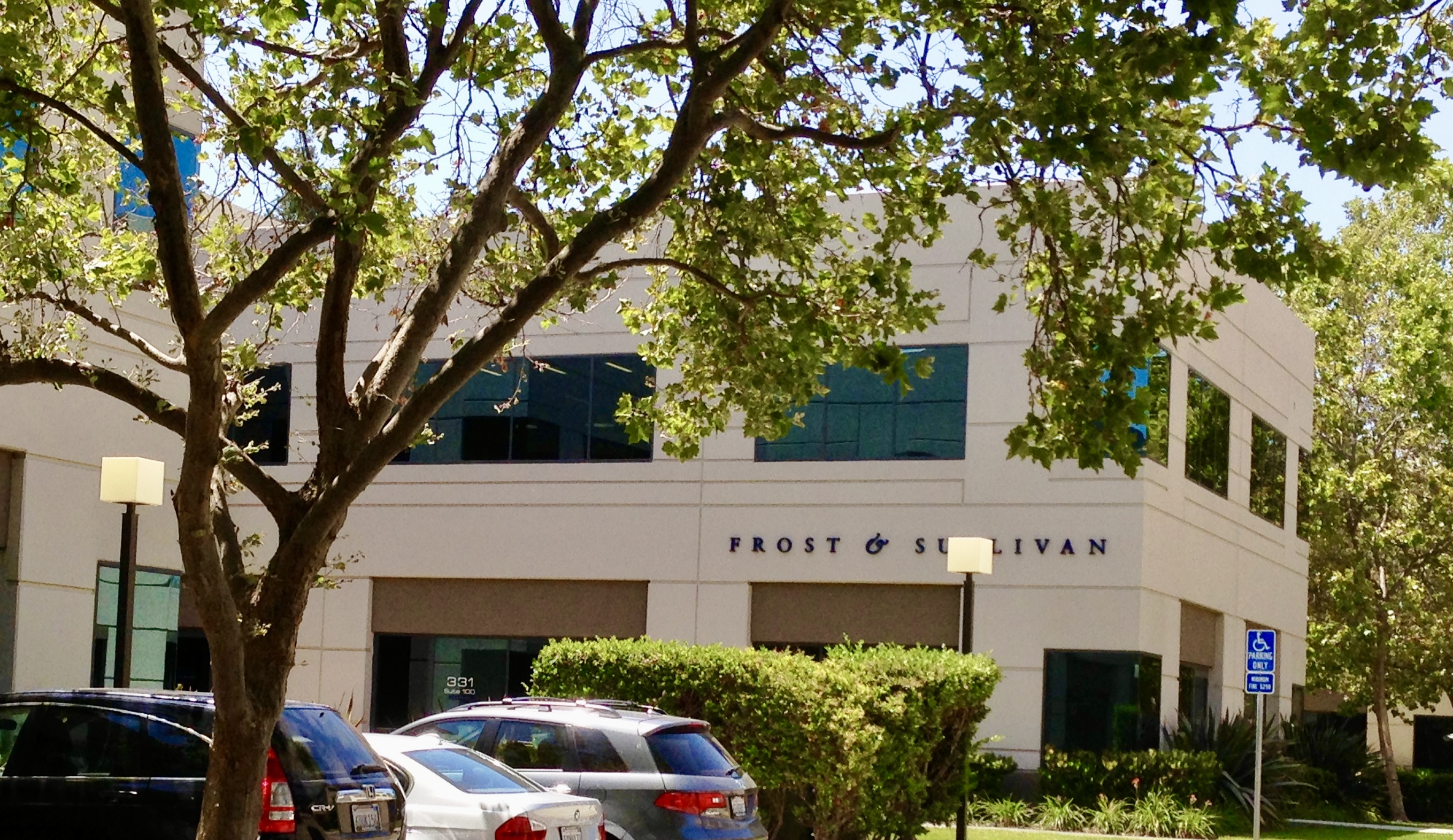
Years ago I was at what were then our Stratecast | Frost & Sullivan offices in Mountain View, California, recording videos for our clients IBM and Carbonite.
When our last video was a wrap, I took off late-afternoon for a powerwalk. Our team pointed me in the direction of a nearby overpass, and the walk was on.
The overpass led to the Stevens Creek Trail and across miles of countryside I couldn’t believe existed in the heart of the Silicon Valley. That countryside actually comprises a series of tech campuses, neighborhoods, and green spaces.
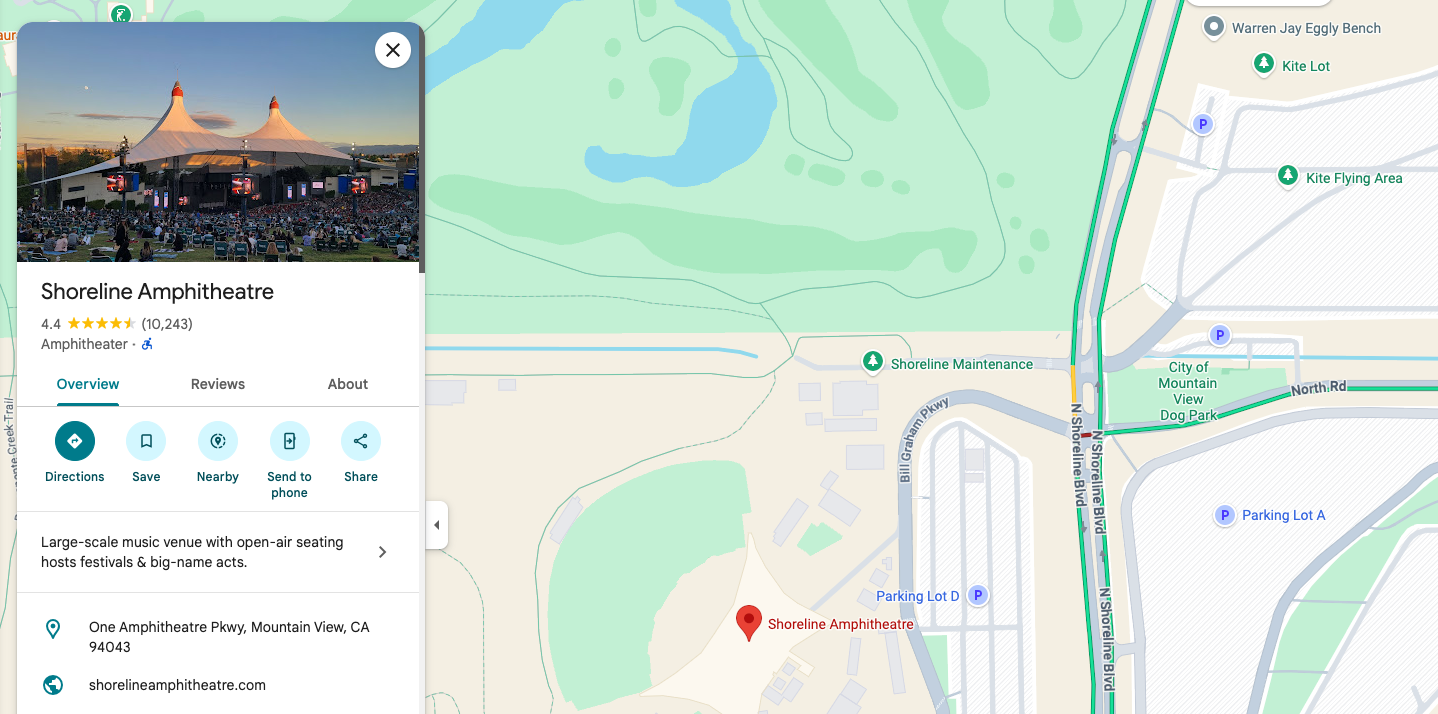
The first major landmark on my quest was the Shoreline Amphitheatre.
A current map in the area around the Amphitheatre shows a Kite Flying Area…
which explains why on the way to the Amphitheatre I powerwalked past someone flying a kite. It does not explain why they were FLYING A KITE WHILE DRIVING A GO-KART, but why not? What a great way to combine two fun activities. And it’s like that familiar phrase: “Go fly a kite while driving a go-kart!”
I would share the video I shot of the daredevil Kite-Flying Go-Kart Rider, but I guess I need special access or something called JetPack to drop a video into a WordPress post, so the image will have to do. Hit me up on LinkedIn and I’ll be happy to share the video.
Anyway, back to the Amphitheatre. The design inspiration for this cultural center came from legendary music promoter Bill Graham, who designed it to look like the Grateful Dead’s iconic ‘Steal Your Face’ skull logo when viewed from the air. From my vantage point at the intersection of Shoreline Boulevard and Bill Graham Parkway, it looked like this:
Another furlong or so across hill and dale and suddenly the current-at-that-time Google logo emerged on a building across the road in front of me. Minutes later I was at the main entrance to the Googleplex, known to Googlers and Nooglers as Plex. My research indicates this iconic glass structure that appears in so many photos may be Google B41.
Walking into this world-famous view, with Googlers and Nooglers streaming in and out of buildings and scrambling on and off vans and buses around me, felt a bit like a spiritual experience.
Stan the Dinosaur is a full-size bronze replica of the skeleton of a Tyrannosaurus Rex who menacingly greets visitors to a courtyard at Plex. (Rex at Plex™?) Google’s headquarters used to belong to Silicon Graphics, which worked on the first Jurassic Park movie. One story says that Silicon Graphics installed Stan at the campus and Google decided to keep him after acquiring the complex. Another says Google simply decided to install a giant skeletal T-Rex at the Plex. The first story sounds more logical to me, but either way, word is that Stan’s presence reminds Googlers to continuously innovate in order to prevent the company from becoming a dinosaur.
Stan somehow managed to elude my photographic eye that day, but I wanted you to see him, so I added this free-to-use image to the post.
I would share the video I shot of colorful picnic tables adjoining some gorgeous waterfall steps later in my journey, but again, the photo will have to do.
As I wound my way back from my Plexiful dream to the hardscrabble streets =:-D of the surrounding area, I passed by Google facilities at 1616 Shoreline Boulevard and 1708 N. Shoreline Boulevard.
Industry insiders will tell you The Valley can be ugly in some ways, but on this day, my corner of The Valley was peaceful and beautiful. And at just under 26,000 steps, or about 13 miles, it was a GREAT fitness day!
Every time I get on a plane I have thoughts about mortality and eternity. This post shares part of its title with a song by Joe Walsh, and the title sums up how I’m feeling about things as we all go hurtling toward 2026 together.
Except for a two-year happy hiatus in Rifle, Colorado, and summer escapes to Newfound Lake, New Hampshire, much of my childhood through sixth grade was a nightmare. Over the years, though, I’ve had more fun than pretty much any 3-to-5 people I know and some minor rock bands.
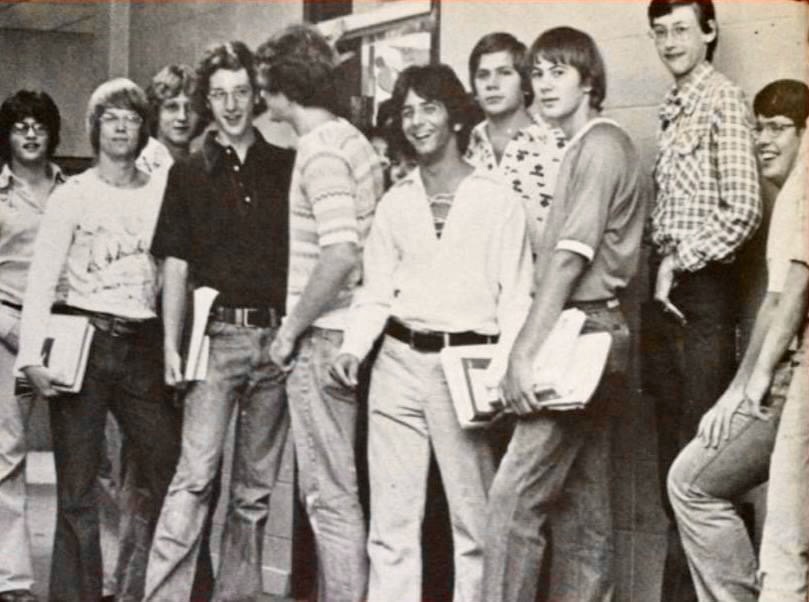
Yearbook hallway scene at Grissom High School, Huntsville, Alabama; thank you, Lynn
I’ve anticipated or survived four acquisition-to-downsizings and a chapter 11 filing by my employers to build what so far is an amazing, rewarding career, on track for a decent retirement if I ever do retire someday. All while having had the honor and good fortune to help our children and their loving spouses, in what may be the worst home ownership era for first-time buyers in modern history, buy their first homes.
I revel in the love of my beautiful family, now including a grandson and a grandpup…and our other pups who have left this world…whom collectively are the greatest people and creatures I have ever known. Only our kids post photos of their little loved ones online, so I’m not posting them here, but trust me, they’re beyond adorable.
Glorious Family Disney Trip: Michelle – Chris – Heather – Courtney – Joanne – me / This post’s featured image is from a maybe-even-more-glorious Family Royal Caribbean Cruise
I love what I do today at Cockroach Labs and have done at MongoDB, Gartner, Stratecast, and elsewhere; in our home and on our property; at the gym, in parks, and on walking trails; and at some great winetasting and craft beer venues.
I value dear friends and just met two of them, Doug and Ben, for a festive dinner at Carraba’s, Parkway Place, Huntsville. Shoutout to our son (-in-law, but to us he’s our son) Chris for getting me a killer deal at a really nice Marriott property for that trip.
We have some wonderful neighbors here in roughly the center of the US who have more than made up for the nightmare neighbors we endured in years past on one of the coasts.
I love the world-class sounds I hear in my Edifier headphones and Apple AirPods, from gorgeous, soaring movie soundtracks to high-speed, piledriving, intense-but-for- the-most-part-not-openly-evil hard rock and metal. Many you’ve heard of and many more you probably haven’t.
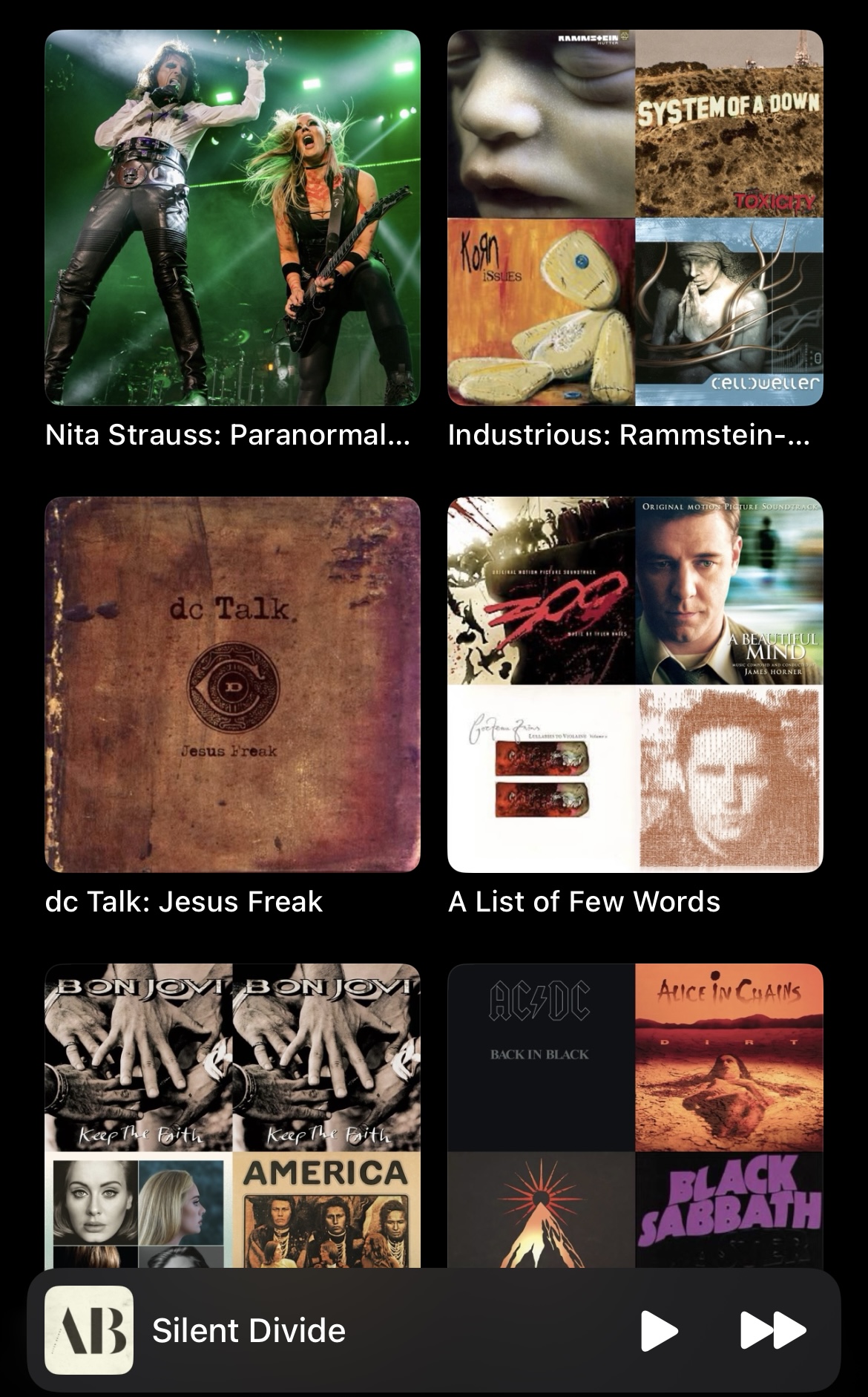
As you may see in the image above, I never fall in line with ‘selected top lists’ of anything, starting with music. Can’t buy all the way into the issues and platform of any one political party, so I’m a Registered Independent.
I’ve never smoked, vaped, or used chewing tobacco in my life—with two glaring exceptions. Tried one cigarette on a Fish-and-Game Club overnight school trip in I think 5th grade, and hated it. One Saturday during high school, a bunch of us were playing a pickup game of baseball and one of the guys gave me a big chunk of chewing tobacco to try, “because big leaguers do the chew.” Five minutes later I made a diving circus catch of a long fly ball—and swallowed the whole chaw. Laid on the field for a half-hour before I felt like I could move again.
Hardest drug I’ve ever used is pot, which I never paid for but always seemed to happen upon for free from generous friends at parties in high school and my first year of college at Auburn University. That is, until 3x with different friends in far-flung locations, my respiratory system started shutting down after a few tokes. No more pot for me! Years earlier I had found myself sitting in a car in a darkened parking lot after closing time with some guys at my first job at a pizza place in Huntsville. Some of them were doing tabs of acid (yep, LSD), and one piped up: “It’s your first time, Jeff, so you should probably just do half a tab.” Did NO tabs 😊 and kept drinking my beer.
After decades of quiet-quitting meat by not eating lamb or veal because they’re baby animals, in 2016 Joanne and I, at Heather’s suggestion, went full Vegan. Yet, while Field Roast and Follow-Your-Heart produce delicious vegan cheeses, Violife makes a true-to-life Parmesan block for grating over pasta, and Hellman’s vegan mayo tastes better to us than the eggy original, no one has nailed the art of vegan cheese that works well on pizza. Good pizza is essential eating, and I love omelets and egg-and-cheese breakfast sandwiches. So a few years later we dialed it back to Vegetarian 🌱 and take B12 daily to supplement the meat we’re not eating.
I own arguably the most bada** shirt you’ll find in fine vegetarianwear, featuring the Slayer logotype
Do I love making cocktails? SEE: image below.
My family got me this shirt featuring the logotype from The Godfather
So, back to mortality and eternity. While I guess I might like to live forever, my life has already been blessed-to-spectacular. My stock phrase about whenever my time on Earth comes to an end: “It’ll save me a lot of work next month.” And if the loving animals who have been a part of our lives somehow do not get into Heaven with my family, but are herded away to Pet Heaven, I plan to arrange a Park Hopper Pass with God. That way I can go from where I’m pretty sure I’ll be—a slice of cosmic real estate I call Permanent Purgatory—and travel between People Heaven and Pet Heaven, like on weekends, or on Mondays when park traffic is lighter, so I can visit those I love most for eternity.
You want more, discerning readers, on Permanent Purgatory? Good call. To me, New York Times bestselling author Dave Barry is the greatest humor writer who has ever lived. Dave’s in a band with other writers and authors, the Rock Bottom Remainders, and he’s always calling out phrases that might be good band names. So I like to think Dave might say: “Permanent Purgatory would also be a good name for a band.”
Dave posing with one of the myriad of masterpieces he has authored: Best. State. Ever, about his home base of Florida
I’ll now bring this post to a close with some shameless plugs for Dave (which, to be clear, he did not ask for and knows nothing about):
If you put out materials for recycling, do you know where they go?
We’ve been recycling for decades, first in California and since 2016 in Indiana. In California, at least where we lived, it was mandatory; we were given three stackable mini-bins to separate plastic/glass/paper and a green waste cart the size of the regular trash cart. In Indiana we pay an extra fee to get our loaded-to-the-gills recycling cart picked up every two weeks, while our nearly-empty trash cart is picked up faithfully every week.
Alert readers may have spotted “high seas” and “gills” and thought: foreshadowing. I invite you to keep paddling. But first, a quick reality check: this is not a climate activism/Green New Deal treatise. To us, recycling is not political. It’s logical, and responsible. It comes from being raised to fix, mend, and reuse things whenever you could instead of, in Mom’s words, “throwing away and buying new.”
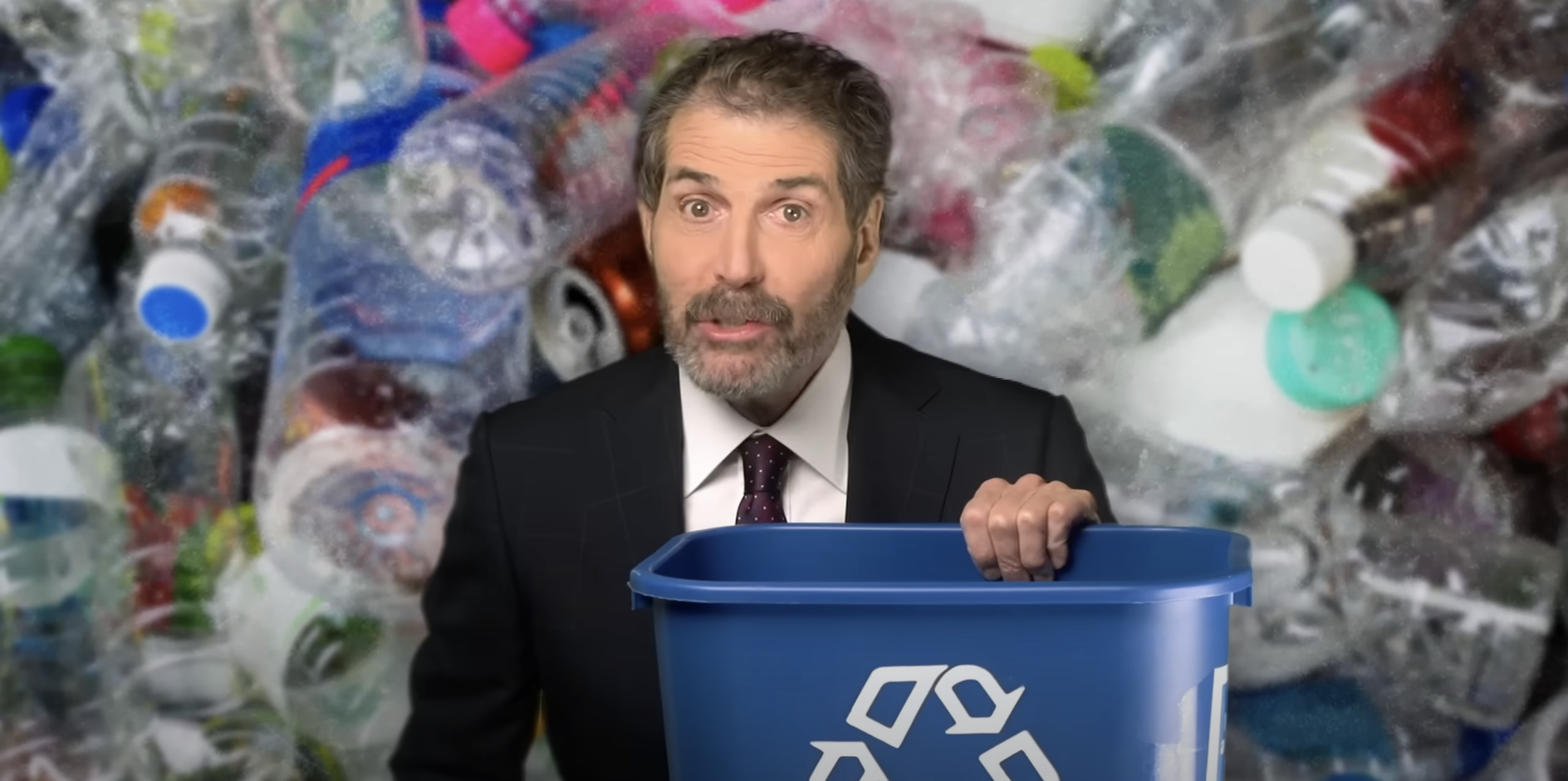
In addition to recycling, another thing we’ve done for decades is enjoy and learn from reports by common-sense independent reporter John Stossel. One of his recent videos showed how companies and countries are shipping plastic “recycling” to various parts of the world, creating plastic mountains on land and floating masses of plastic in the world’s oceans, including…
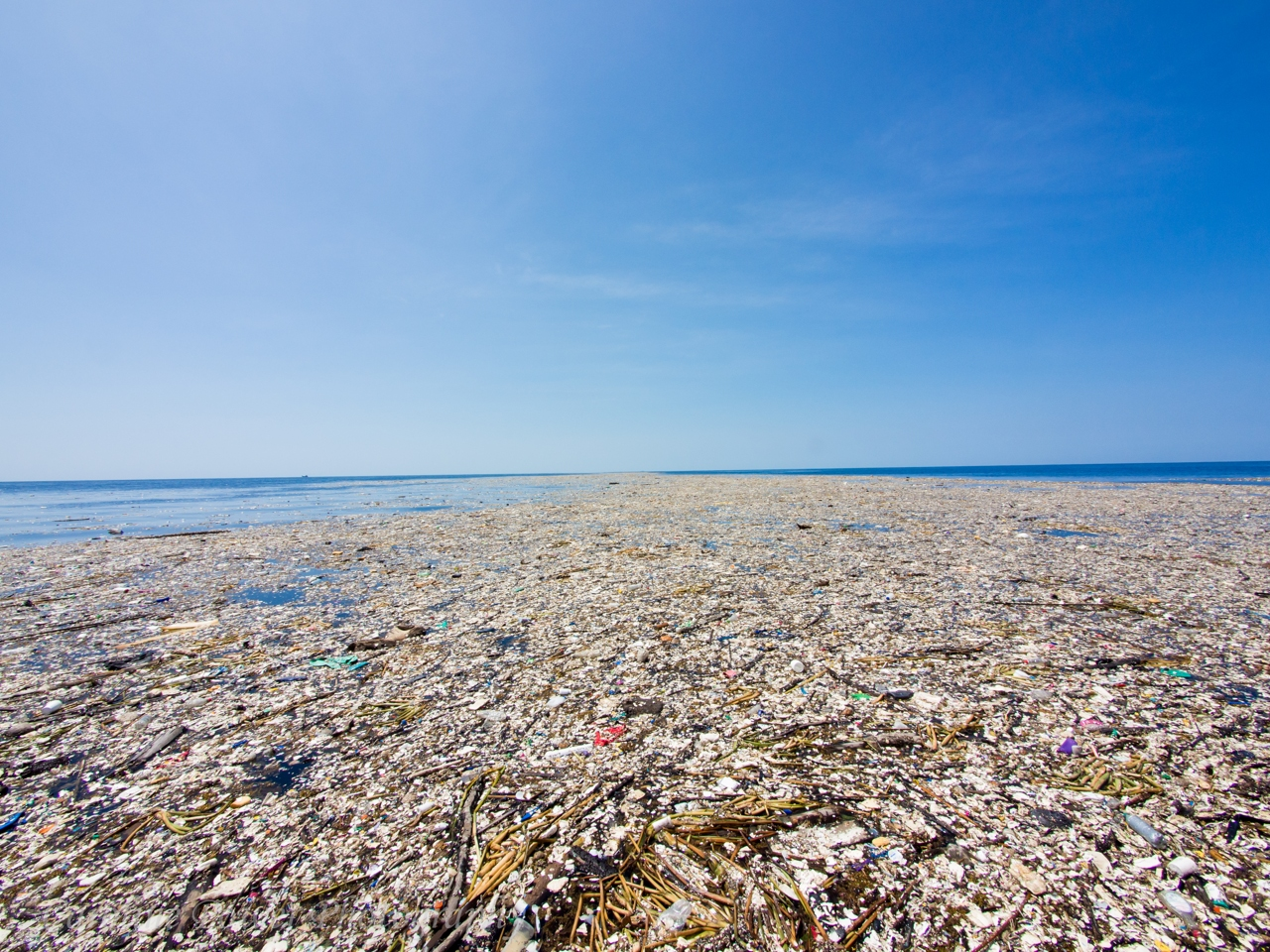
The So-called ‘Great’ Pacific Garbage Patch
This man-made monstrosity is made up of the ugly, drifting remnants of what passes for human civilization today. Per National Geographic, the Great Pacific Garbage Patch is a murky soup of plastics in the North Pacific Ocean, also known as the Pacific trash vortex.
The Patch actually comprises two sub-patches: the Western Garbage Patch, in Asia-Pacific waters, and the Eastern Garbage Patch off the US West Coast. This bifurcated blight is actually composed of many separate floating islands of plastic and other debris that have loosely coalesced into larger masses.
Accurate 2024 data is hard to come by, but data from 2018 is sickening enough. Researchers from the Ocean Cleanup project calculated, as quoted on Wikipedia, that by 2018 the Patch already covered 620,000 square miles and contained somewhere between 45,000 and 129,000 metric tons of plastic. Years later, by the end of 2024, Ocean Cleanup had removed more than a million pounds of debris from the Patch — which by then was a maddeningly minuscule 0.5% of all that was out there. Some of the plastic in the Patch is 50 years old.
All of this had us ready to start placing our plastic “recycling” in our trash. We figured it was better to force them to deal with it in the US than have it shipped off to strangle fish and birds in the world’s oceans, or pile up in faraway lands.
First we posed some hard questions to our waste management provider. What we learned in a thoughtful, personalized response from Republic Services has us continuing to place plastics in our recycling bin — and trying to connect Republic and Stossel for an interview.
What Republic Services is Doing About Plastics
For material to be recycled, there must be an end market for it: a customer who wants to reuse that material. In the US today, there are robust end markets for PET (plastic #1, such as water or soda bottles), HDPE (plastic #2, such as milk jugs or detergent bottles), and Polypropylene (PP #5, including things like yogurt cups, margarine tubs, and to-go cups). Other plastics, for which there are limited end markets, include flexible plastics like grocery or trash bags, and Styrofoam.
Republic Services operates 75 US recycling facilities that recycled 300 million pounds of plastics in 2024. Republic told us PET, HDPE, and Polypropylene make up more than 90% of the plastics it collects and processes at its recycling facilities. As Republic customers putting these items in our blue cart (which Republic delivery support calls a “toter”), our household plastics are getting recycled, and in North America: Republic does not export plastics overseas.
Today many plastics are downcycled into things like carpet, clothing or construction pipe. While this is better than sending materials to a landfill, there are few options for further recycling of these products, so ultimately they become more waste.
It is literally, to borrow an overused political cliche, “kicking the can [or in this case, plastic bottle] down the road.”
To stop recycling from being a one-and-done affair, Republic Services is currently developing a network of plastics recycling facilities it calls Polymer Centers to help ensure bottle-to-bottle circularity: enabling a water bottle to be recycled into another water bottle, a detergent jug to be recycled into a new jug, and so on, to keep the materials within the Circular Economy over the long term. The company began operations at its first Polymer Center in 2023, and as this post goes live it is getting ready to officially open its second one, in Indianapolis, in 2024.
“But Only 9% of Plastics are Recycled. It’s a Losing Battle.”
A frequently cited statistic is the EPA figure that only 9% of plastics are recycled. While this is accurate, it is also misleading, because it refers to all plastic produced, including durable goods like auto dashboards and bumpers, consumer electronics, and medical devices. Those aren’t manufactured to be recycled — at least not through existing, large-scale recycling processes. Republic did not provide insights into what can be done, or what it may be planning, to deal with that other 91%. If I had to bet where a solution will someday be found, though, my money would be on a recycling-forward provider like this one.
Sole-source Recycling (One Cart) is Better. Government Apathy is Not
Other questions we asked were: When are you going to make recycling required in Indiana as it was for us in California? And when are we going to get stackable mini-bins to separate plastic, glass, and paper? The reality is that Republic Services and other waste management companies can’t mandate recycling; they contract with customers to provide the services they choose. Republic noted that Indianapolis is the largest city in the U.S. without regular recycling service, and that city leaders must decide to offer or mandate recycling. We love Indy’s big-city culture, major sports, fine dining, low-hassle airport, and more, without the big-city problems that plague other metropolitan areas, but it is behind the curve on recycling. Living 45 minutes out of Indy, we’re even further off the pace. There is some good news, though: our city now applies a discount to the trash portion of our Republic bill to compensate in a small way for the fact that we choose to pay extra to voluntarily recycle.
CTA: What Are YOUR Waste Hauler and Local Government Doing About Recycling?
What we’ve learned leaves us wondering what other waste management companies and governments in all of the so-called “advanced” nations — those of us who consume the most products and create the vast majority of the world’s plastic waste — are doing about this.
Some of the best pieces of communication leave you with a call to action (CTA). So here is ours: We challenge you, ALL of you, to ask your waste management company and your local government what they are doing about recycling in general, and plastics recycling in particular. That Disastrous Pacific Garbage Patch (my term) isn’t creating itself, and it’s not going to go away on its own. Unless we want our planet to keep going to hell in a Vinylized Plastic Handbasket, we need to push for every bit of household plastics to be recycled, and new processes to pulverize that 91%.
When you find out what companies and leaders are doing, let me know? Send a comment here.
And John, when you have a moment, can you reply to my email? Or call me?
The inaugural year of the 12-team NCAA College Football Playoff (CFP) in the US has bewildered and enraged fans of the sport and generated comments by broadcasters that often revealed more about their own personal biases and financial connections than their expertise. I’ve commented about the CFP on X, and decided it was time to propose a blueprint for how it might go next year.
I started where I thought the 2024 College Football Playoff Selection Committee was starting, or should have started: the 2024 NCAAF Final Rankings. Rightly or wrongly, conference champions aside, this provides the mythical “top 12 teams who get to compete for the championship” the tournament is supposed to be about. Next, this proposal eliminates what the Committee did this year: awarding four teams home games in the first round, then every other game the rest of the way is a bowl game at a neutral site. A lot of the high-handed and wrongheaded takes about “teams who didn’t deserve to be in the CFP” has been directed at upstarts/challengers who had to take on four traditional college football powerhouses ON THOSE POWERHOUSES’ HOME FIELDS. So Notre Dame, Penn State, Texas, and Ohio State, all at home, beat Indiana, SMU, Clemson, and Tennessee, respectively. Few of the so-called media experts and social media catcallers have had the intellectual honesty to admit that most other powerhouses/football factories — including their favorites who didn’t make the CFP — would have lost those games in football-crazy hostile environments, too, and lost big.
Did #1 seed Oregon get a home game in the second round? No. It got a neutral site bowl game against what many fans now think may be the best team in college football, Ohio State, and lost handily.
On to the proposal, laid out as it would have looked using the NCAAF Final Rankings above. It makes the regular season meaningful by pitting 1 vs 12, 2 vs 11, and so on, and continues that pattern throughout the tournament with remaining high to low seeds.
1st Round would have been: 1 Oregon vs 12 ASU 2 Georgia vs 11 Alabama 3 Texas vs 10 SMU 4 Penn State vs 9 Boise State 5 Notre Dame vs 8 Indiana 6 Ohio State vs 7 Tennessee
Predicted 2nd Round: 2 Georgia vs 12 ASU 3 Texas vs 6 Ohio State 4 Penn State vs 5 Notre Dame
Predicted 3rd Round: highest remaining seed gets a bye (the only one of the tournament). The other 2 play: 6 Ohio State vs 12 ASU
Predicted Championship Game: 5 Notre Dame vs 6 Ohio State
A final word about first-round home games
Although I’ve heard no explanation from the Committee about why four teams out of 12 got home games in this current CFP, I’m anticipating it might be along the lines of, “There aren’t enough bowl games, we needed to add four home games to make it work.”
Not buying it.
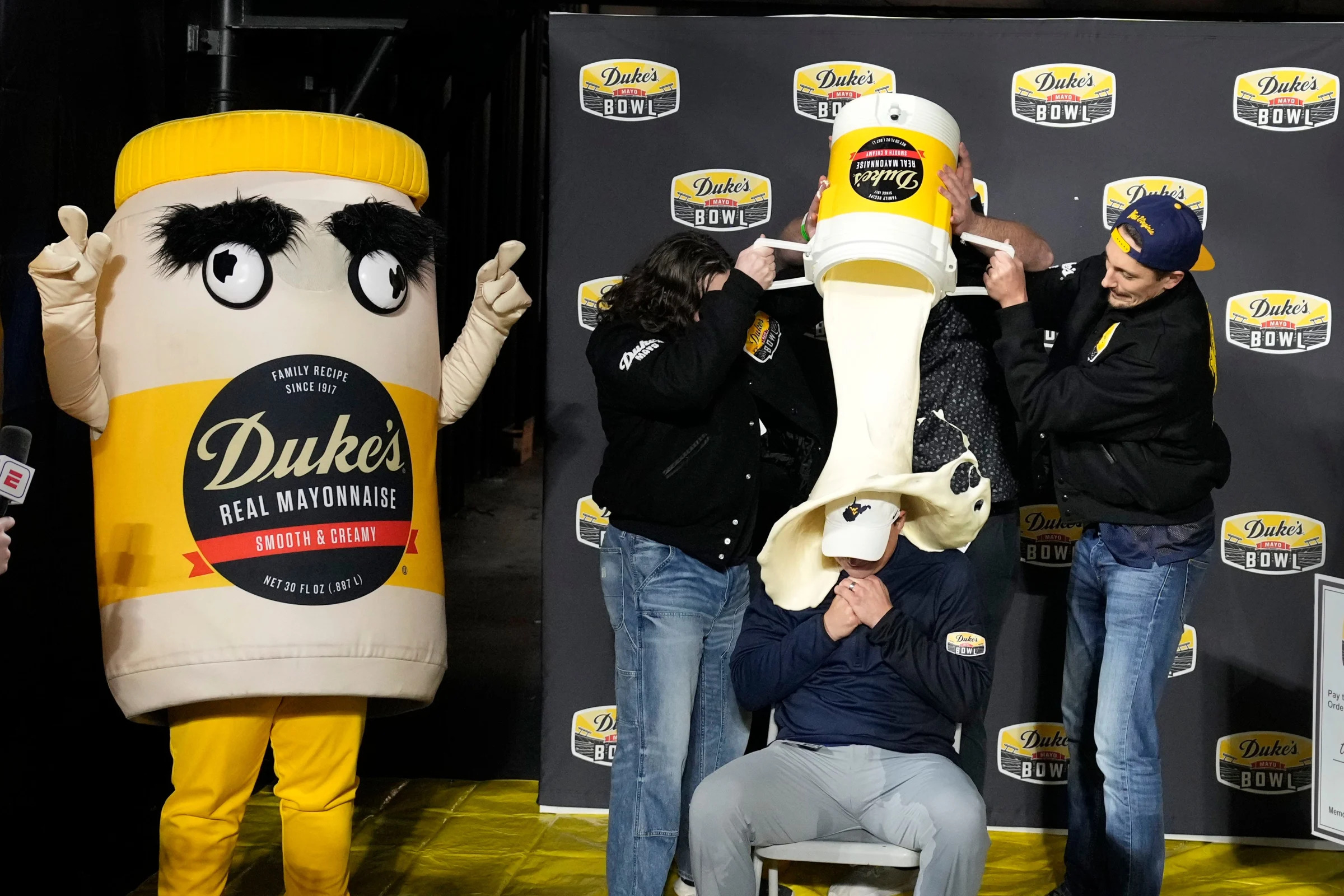
This expanded playoff has been discussed for years (and years, and years) before it finally materialized in 2024. What used to be a select lineup of college bowl games has ballooned over the years into a menagerie of colorfully-sponsored and -monikered bowl events including the Wasabi Fenway Bowl, the StaffDNA Cure Bowl, the Bad Boy Mowers Pinstripe Bowl, the TransPerfect Music City Bowl, and the Duke’s Mayo Bowl.
DON’T tell me there aren’t enough neutral-field bowl games to host four more. Or, if there truly aren’t: invent four more. Failing that: make EVERY game of the CFP a home game for someone, based on the high-to-low seeding above, and leave the neutral-site bowl games to the many other deserving teams across the nation.
Best way to watch: SKYCAST
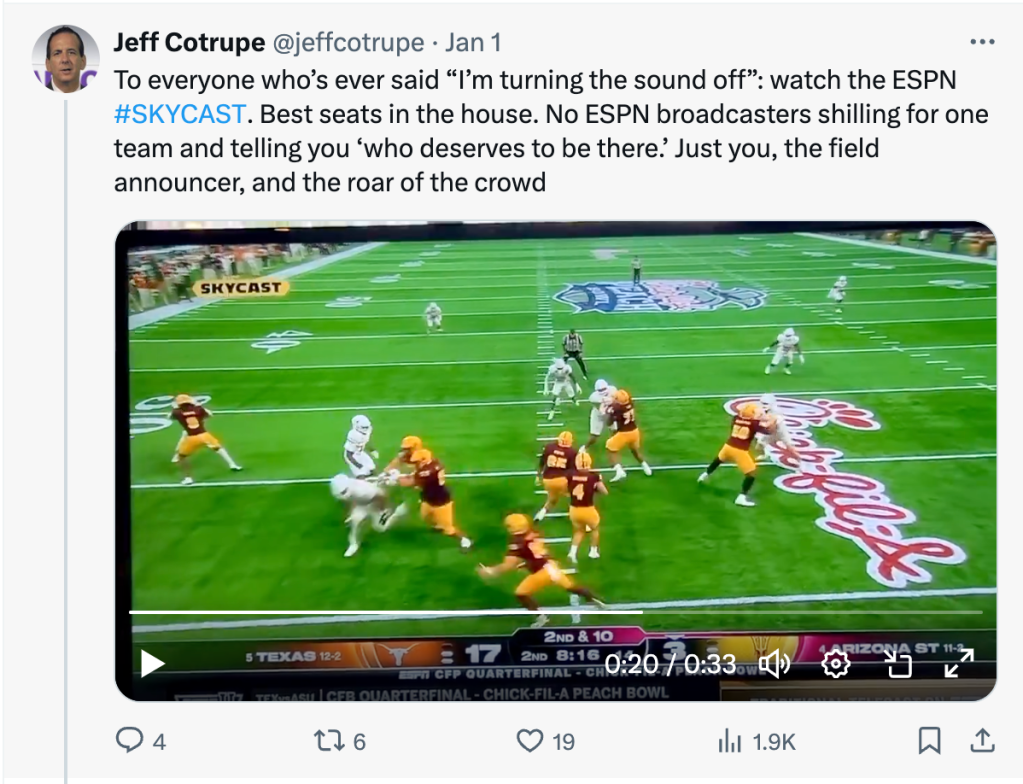
ESPN seems to find new ways daily to turn off fans and observers, including me, but when I do watch games on the network, my favorite way is now SkyCast. If ESPN offers SkyCast for a game, it appears on one of the ESPN channels adjacent to the main broadcast. (As does Command Center, a multi-screen enhanced version of the main broadcast.) To reprise my X post, on SkyCast you get the best seats in the house. No ESPN broadcasters shilling for one team and telling you ‘who deserves to be there.’ Just you, the field announcer, and the roar of the crowd.
During the 2024 US Presidential campaign, candidate Donald Trump indicated strong support for cryptocurrencies, attended the annual Bitcoin Conference, and even theorized the US might help pay off its national debt with crypto. In the wake of Trump’s election to the Presidency, Bitcoin ($BTC) hit $100,000 per coin (current price here). As always, its sharp rise brought out two competing camps: cheerleaders/profiteers urging investors to “get in now,” and naysayers telling anyone who will listen to keep their (real) money in their pockets because crypto is a scam.
My own take on crypto also offers dual (and dueling) choices. I believe the crypto community can either [1] make Bitcoin or potentially another coin a global standard buyers and sellers can rely on to deliver and hold value in everyday transactions; or [2] continue pushing crypto as an investment vehicle/get-rich-quick scheme. [If you haven’t heard Nikki Glaser’s beyond-hilarious set on the Roast of Tom Brady on Netflix, including the bit of the night about Brady losing millions on crypto, enjoy that killer bit here.]
The first and often only rationale you’ll hear from crypto naysayers is, “It’s not backed by anything.” Reality check: all currencies not backed by a physical element such as gold — like, for example, the world’s currency of record, the USD, since the US took it off the gold standard in 1971 — have value only because people and markets agree they do. So “they’re not backed by anything” is a willfully uninformed reason to cast aspersions at Bitcoin and other cryptocurrencies.
What does feel different to me about Bitcoin is that it seems way less about “being a currency” and way more about “I wanna get mega-rich on Bitcoin like the Winkelvoss twins” of Facebook fame/infamy. Having navigated the whole less-than-scrupulous mystery world of “You’d better get a digital wallet to protect your crypto, if not anyone including us can steal your crypto holdings from any crypto exchange, but wait that’s the wrong kind of wallet” makes it indeed feel like a scam. It also appears designed to discourage the critical mass of normal citizens and consumers from using it as, you know, a currency — TO PAY FOR goods and services.
Crypto has served solely as an investment vehicle for us thus far, a tiny fraction of our holdings, and I’m happy to keep it that way. In a recent year Coinbase stopped dealing in Bitcoin Cash (BCH). This was interesting because we never wanted any BCH, and the only reason we held any in our account was that Coinbase had previously converted another coin into BCH. In Coinbase-Manufactured Transaction #2 — where Coinbase made it impossible to move our BCH elsewhere, liquidated it, and converted it to yet something else — it took a sizable percentage of the proceeds from us for “fees.” I have a life to lead and it wasn’t life-changing money, so the documentation and screenshots lie dormant on file, ready for future action.
This kind of unsavory behavior from Coinbase, and similar conduct by Robinhood, firms that are supposedly safe harbors for non-criminal regular investors, make Theory #3, “Crypto is a Scam,” the leader in the clubhouse.
So honored! I’m a CMA Top 100 Influencer & Strategist for 2024. Grateful to the amazing customers, partners, and colleagues who make it all possible! Thank you to everyone at Base (formerly Crowdvocate) for making this possible. Base’s mission is to maximize revenue through engagement by taking your customers and teams on a journey for higher retention, lifetime value, and advocacy.
Exciting news! 🎉 I’ve been named a CustomerX Impact Award finalist in the Market Trailblazer category, recognizing those making the biggest impact on growth through building world-class programs. I couldn’t be more honored. Thank you to the amazingly innovative customers and partners who make it all possible! 🏆
Winners will be announced at CustomerX Con in Boston, October 17-18, 2023. That’s the video link above. Learn more, and see our smiling (in my case, talking) faces on the Award page.
I have detailed thoughts supporting each of these, but we live in an era of TL:dr. So to encourage you to read this, and maybe to care and act, here are the key points of the plan:
1) Make the death penalty the law of the land for any violent crime, which I hereby define as child sexual abuse and up, regardless of the age of the assailant. No plea deals. [Federal law]
2) Eliminate or supersede laws that prevent the state from helping the mentally ill if they or their families “don’t want to be helped.” [Federal law]
3) Force schools to address the serious bullying that has provably and directly led to a number of these shootings. Schools who ignore issues and do not immediately engage law enforcement face legal action. [Federal-state-local action]
4) Enact serious gun control including a ban on all semiautomatic weapons and high-capacity ammunition — not just AR-15s but any handgun or long gun that shoots many rounds in seconds — and a mandatory federal buyback program to compensate owners for the multitude of these weapons that are already in the field. “Then only criminals will have them”? See #1 above. [Federal law]
5) Make parents financially and legally responsible if any immediate family member ever commits a violent crime. [Federal law]
6) Return freedom of voluntary (not mandated) prayer to the schools and all public places. [Federal law]
7) Return the every-morning Pledge of Allegiance to schools. [Federal law]
8) Ban assault media. Get serious about banning or seriously limiting violence in all forms of entertainment from gaming to TV to movies to music. [Federal law]
9) Install metal detectors at the doorways of schools, malls, theaters, and other currently-unprotected public venues. [Federal-state-local action, public-private partnership]
10) Hire expert marksmen/sharpshooters for all schools, malls, movie theaters, and other currently- unprotected public venues. [Federal-state-local action, public-private partnership]
11) If anyone breaks into any public or private place, or even without breaking in pulls a weapon on anyone in any public or public place, any citizen and anyone acting on their behalf has the right to injure or kill the threatening party without being prosecuted. [Federal law]
12) No one who is hurt or killed while they themselves were in the commission of a criminal act as described in #11, nor their families or friends, nor anyone else on their behalf, shall be allowed to bring a lawsuit or negative action of any kind against those who hurt or killed the criminal. [Federal law]
13) Provide tax breaks and vouchers so every family everywhere is free (and supported) to choose homeschooling or charter schools instead of public schools. [Federal law]
14) Ban movie or book deals, or any form of compensation that originated from a violent crime, to the criminal and his or her family as far as their family tree goes, any friends or associates, or anyone acting on his or her behalf. [Federal law]
15) Restrict media mentions of the names of those who perpetrate mass shootings to only once on each media entity’s first mention of the crime. [Federal law]
[REPOST: APRIL 2022] What happens in Vegas: Sitecore Symposium, where Sitecore rolled out the latest version of its Customer Engagement and Experience solution.
Keynote-worthy CEO
Judging by his razor-sharp, on-point keynote, Sitecore CEO Michael Seifert, who I interviewed on an earlier sojourn to Vegas, was born for the stage, personable and well-paced as he spoke to the +/- 2,000 Symposium attendees. The theme of Seifert’s talk and the conference was: “Own the Experience.” Another oft-repeated phrase at the event was “Customers for life.” In fact, Sitecore Chief Strategy Officer Darren Guarnaccia said in his Product keynote: “We want to be the preferred tool for customer experience developers, marketers and merchandisers…this is a platform for life.” In this analyst’s view, Sitecore is well on the way to actualizing that vision.
Quotes & Highlights
Some notable quotes and concepts jumped out of Seifert’s keynote:
“This is the opportunity of our times: to present the right experience at the right time… the most important opportunity in today’s environment.”JeffTake:This is why both customer experience analytics and real-time analytics, two areas of focus for us at Stratecast, are so important today.
“An experience creates a lasting memory, and that beats content…but you must know the person to provide the experience, so that requires context…and, to bring it full circle, you must have creative, emotionally-engaging content.”JeffTake:we’re talking a lot about content and context, plus sentiment analysis, at Stratecast these days, and this encapsulates a lot of the ‘why.’
“Consumers are getting MAD: marketing attention deficit.” He explained they are bombarded with email, then Internet banners and popups, and they tune out whatever is perceived as an interruption or not relevant. JeffTake:this gets to the essence of speaking with and making friends with your customers and prospects, not “marketing AT them,” which is supposed to be the hallmark of digital communications as opposed to so-called traditional marketing.
Key Challenges
Seifert talked about how marketers now have plenty of tools at their fingertips, but that technology is starting to overwhelm them. They face too much complexity; it’s becoming an arms race. He cited stats from the Digital Analytics Association that 50% of marketers’ time is spent gathering and analyzing data. And how, even after they’ve assembled all of that data, they still do not have a comprehensive view of the customer, just bits of it.
Remember, Seifert pointed out, that Amazon, for example, started out only selling online, which makes it simpler. Many organizations, however, have storefronts, distributors, other marketing, sales, and service channels and touchpoints from which they must gather info, and to which they must impart new ways of better serving customers. The idea is to capture all relevant data—but SIMPLIFY.
Sitecore Solution: Customer Experience Platform
Seifert next brought Guarnaccia on stage, and Guarnaccia showed a few dashboard screens from Sitecore’s new Experience Profile. Throughout the event, a number of Sitecorians referred to the Experience Profile as “The exFile.”
Sitecore’s “exFile” (which, come to think of it, could also be a great name for a database of ex-spouses and other partners) provides a current and comprehensive view of the customer. It builds that view based on data flowing into the also-brand-spanking-new Sitecore xDB and its Experience Database, built on MongoDB, with connectors and Sitecore application software. Guarnaccia explained how now you can collect all the information from social, internal, and external sources and really see who this customer is, what they like and don’t like, what they have been doing on your site (and other sites), and all in all, how they are interacting with your business. Thus armed, you can predict what they likely want to do or see next and provide what he termed “experience optimization”: tracking, visualizing, and predicting, then generating dynamic personas and lists for immediate action. JeffTake:first, this discussion points out the importance of Stratecast’s 39 Data Sources Enterprises Need to Access. Second, Sitecore nailed what we have been urging the market to do for years: provide solutions that empower users to ANALYZE, THEN ACT.
Product Keynotables
Next, Sitecore VP Product Marketing Mark Floisand joined Guarnaccia on stage, and the two discussed some of the platform’s recent growth stages: Version 7.0 was about content. 7.1 was mostly about the user interface (UI: the SPEAK framework). 7.2 was about integrating Commerce Server. With 7.5 (the current version as of Symposium), Sitecore re-architected the platform to add the new xDB. In 8.0, Sitecore 8, the company was adding exFile, plus easy test and optimization for all website changes plus integration with Cloud ML on Azure to do predictive re-segmentation and next-best-experience offers. They announced that Sitecore 8 was in so-called “lighthouse” customers now [JeffTake: heavy beta with a trusted shortlist of top customers] and would be available for technology previews in November, with GA slated for next year.
Next, Sitecore partner Coveo dashed up on stage with breaking news: a free version of its enterprise search product for all Sitecore customers.
Commerce Server is an acquired addition and integration of eCommerce capabilities including merchandising, shopping cart, and more. Stratecast met separately with Sitecore Director of Product Marketing Wayne Smith, who told us they have been “skilling up” since the acquisition, and that a number of Commerce people came aboard along with the technology. A recent blog post by Guarnaccia talks about all of this and establishes a Customer Lifecycle that is far more extensive than most of what has passed for “product lifecycle” in the industry for, like, ever. With Commerce Server, Sitecore can now map, monitor, and act on everything from initial customer awareness through consumption and advocacy. JeffTake:this means acting as a reference customer, including on social media and as a positive contributor to things like a positive Net Promoter Score.
Author and marketing and sales strategist David Meerman Scott was an entertaining guest speaker, emphasizing, among other things, “humanizing” [personalizing] marketing. He also hit the real-time button HARD: ahh, a speaker after Stratecast’s real-time-data-espousing heart.
Other Insights
Microsoft has named Sitecore its top independent software vendor (ISV) partner several years running. Sitecore VP Business Development Jean-Paul Gomes told us “the Microsoft connection” pulls through major revenues for Sitecore. Gomes is an ex-Microsoft exec who is still well-connected there and spends much of his time at Microsoft’s Redmond, WA, campus. Sitecore’s partner roster reads somewhat like the Library of Congress, but the company told Stratecast it is moving toward having fewer partners to focus on bigger targets. That sound like “we’re going up-market” to me.
Like virtually every provider, Sitecore strives for replicable processes, but the fact remains that most Sitecore implementations are still one-off affairs because organizational structures, politics, digital maturity, and technical challenges are always different. Sitecore’s SBOS (Business Optimization Services) offering helps with this, and Sitecore has a number of implementation partners it certifies for various competencies.
Sitecore also offers solutions including Komfo (social media monitoring, analytics and publishing) and Print Experience Manager (formerly Advanced Print Studio, or APS), but did not heavily emphasize these at the conference. Nor was there talk about privacy and security in any of the sessions or briefings we attended. Best insight on privacy was an answer from panelist Avanade: “Get tight with your legal team.” (Avanade is a Microsoft/Accenture partnership that provides consulting, implementation management, and managed services.) We at Stratecast have a LOT to say about privacy…but hey, that’s part of why we are here.
As the cynical analyst, I keep wondering how Sitecore can continually remake and reposition itself to meet changing markets:
In years past, the biggest name in chargeable web content management (WCM, which, btw, is still raging full force under the hood)… Add analytics and marketing automation and it’s a customer engagement platform…
Now a MongoDB-fueled customer experience solution.
Somehow Sitecore does it. Or is doing it. Again. Remember, GA of Sitecore 8 is not until sometime next year. So the jury is still out, the pudding is not really proven, etc. — we’ll see what we see when Sitecore 8 hits the market next year.
Many Sitecore customers are running multiple instances of the platform and using different aspects of it, depending on their varying levels of digital maturity. Additional functions are being added and carefully integrated, because Sitecore’s most advanced customers want them and Sitecore believes all customers will need them.
Event-wise, Sitecore Symposium was really well managed. Oh, and each attendee got a copy of the bookConnect: How to Use Data and Experience Marketing to Create Lifetime Customers,written by three Sitecorians: Lars Birkholm Petersen, Ron Person, and Christopher Nash.
In fact, hey wait a minute, this analyst provided a quote for the book and I’m still waiting for my copy signed by the authors, or at least by Petersen. How about it, Sitecore?
[First published in 2019, but an ongoing labor of love updated as recently as February 2022]
To me, “going vegan” was not about being trendy or better-than-thou, showing anyone up, or guilting anyone into doing what I have come to believe is the right thing. It’s just what my wife and I have done in our household after our younger daughter introduced us to it back in 2016.
Below you’ll find links leading to literally thousands of choices ranging from tasty to delicious to downright delectable. In this piece, we:
Lead off with the fast-growing lineup of plant-based fare available at restaurants and on the go
Move from there to the incredible diversity of plant-based foods ready to tempt your tastebuds on the homefront, including (yes) “The Tesla of Chicken”
Follow it all up with Q&A, the science, thoughts, and opinions
A programming note: this post is rigorously sourced, but I couldn’t get references to click to the endnotes for you. Links that simply open to company websites and the like, not part of a news story, are embedded in text. Those sourced from research reports and news stories have a notation, from |a| to |z| and more. Either way, all links open the way God intended them to: in a new tab =;-D At post’s end you’ll find all endnotes with sources, titles, and the same links.
Eating On the Go: Plant-Based Burgers ROCK
These burgers feature something that would surprise those who haven’t tried them: THEY TASTE GREAT. Even if I weren’t a plant-based enthusiast, I would never go back to “regular” burgers.
As reflected in the opening image, we love Beyond Meat Burgers at TGI Fridays. Having had every burger Fridays makes over the years, to us these are the best and tastiest on the menu. We are also proud and happy $BYND shareholders.
Burger King rolled out its Impossible Whopper to rave reviews across the US and Impossible products are available in a handful of other countries. Beyond Meat products have far greater reach, currently sold in the US parts of EMEA, APAC, and Latin America. Both companies are of course looking to expand into other markets.Continue reading


























 It Was Just a Thought™